
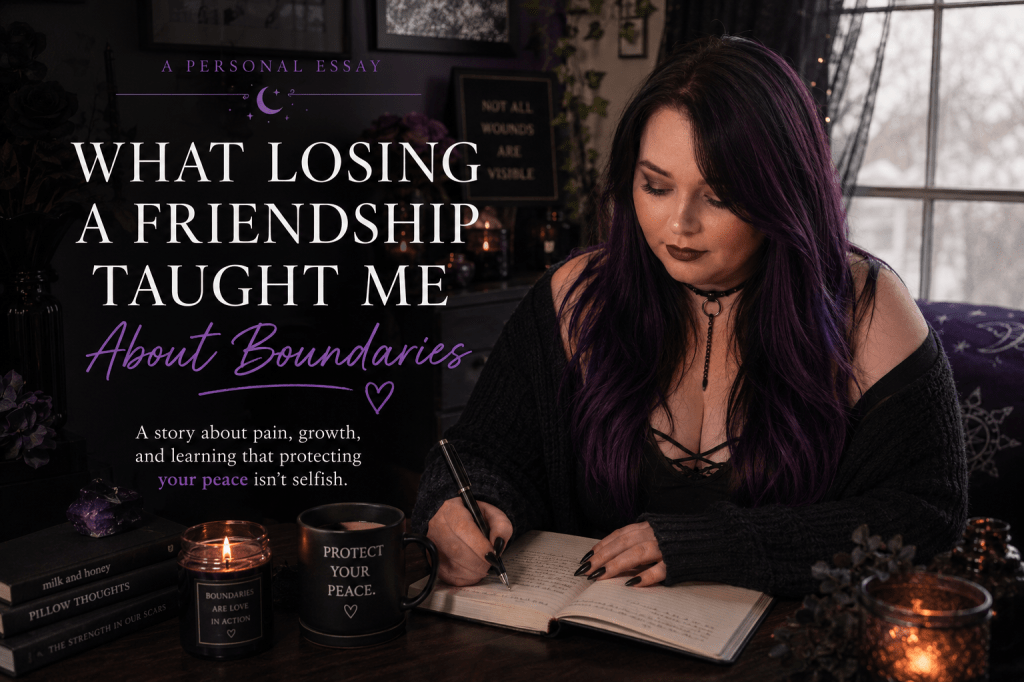
Author’s Note: To protect the privacy of those involved, all names in this story have been changed. ***CAUTION SOME THEMES MAY BE UPSETTING FOR SOME READERS***
When people think about heartbreak, they usually think about romantic relationships. There are countless articles about surviving a breakup, moving on from an ex, and learning to love again. People understand that kind of grief. They ask if you are okay. They remind you that time heals. They tell you you will find the right person someday. Friendship heartbreak is different.
There is not much conversation about what it feels like to lose someone who was never your partner but still played a significant role in your life. There is not a guide for mourning someone who is still alive, still living their life, but no longer has a place in yours. For a long time, I did not even realize I was grieving. I thought I was just trying to fix something that had broken.
Looking back now, I realize I was not grieving the friendship alone. I was grieving the future I thought we would have and the version of someone I believed would always be there when I needed them most.
The Friendship That Slowly Grew
I met “Megan” during high school. If I am being honest, we were not the kind of people who instantly became inseparable. We were different in a lot of ways, and I do not know that we would have naturally become close if life had looked a little different. But life has a funny way of bringing people together.
Megan did not have much of a support system. Outside of our friend group, she did not really have many people she could lean on, and because I cared about her, I naturally became one of those people. We spent more time together, talked more often, and somewhere along the way she began referring to me as her best friend. I do not know if I would have used that word for our friendship at first.
Not because I did not care about her—I absolutely did—but because our friendship grew gradually instead of all at once. I cared about her deeply, and that mattered more to me than whether we were exactly alike.
Looking back now, I realize that some of the strongest friendships are not always built because two people are perfect matches. Sometimes they are built because one person needs someone, and the other chooses to show up. I wanted to be that person.
The Discomfort I Kept Trying to Ignore
Around the same time, another person became part of our friend group. I will call him Ryan. The truth is, Ryan had been part of my life long before he became part of our group. I first knew him in middle school, and even then, his attention toward me made me uncomfortable. Friends would tell me he was taking pictures of me and sending them to other people. They would tease me about him, assuming it was harmless because he liked me. I never experienced it that way.
I remember dreading moments where I knew I had have to interact with him. I remember feeling anxious before classes where I could not easily avoid him. At that age, I did not have the language to explain why those feelings mattered. I just knew something did not feel right. As high school went on, that discomfort did not disappear. It grew.
Ryan’s comments became harder to laugh off. The attention became more persistent. There were moments where he made it clear he wanted to date me, and later, moments where his words made me feel like he no longer saw me as a person at all. I tried to tell myself I was overthinking it. I tried to be polite. I tried to be understanding. Most of all, I tried to convince myself that if I stayed kind, things would eventually settle down. They never did.
Learning to Make Myself Smaller
Something I have spent a lot of time thinking about over the years is why I did not speak up more. The answer is not simple. At that point in my life, I was not just navigating uncomfortable situations within my friend group. I was dealing with unhealthy relationships, harassment, and other experiences that constantly reminded me how quickly a situation could escalate if the wrong person felt challenged.
Without realizing it, I had started teaching myself that staying quiet was safer. That laughing was easier than arguing. That pretending I was okay required less energy than explaining why I was not. For a long time, I thought that made me easygoing. Now I understand it was survival. Looking back, I wish I could sit beside my younger self and tell her that discomfort does not need permission to be valid. You do not have to wait until someone else agrees that something crossed the line. You do not have to collect evidence to justify your feelings. Sometimes the fact that something consistently makes you feel unsafe is reason enough to take yourself seriously. I just had not learned that lesson yet.
The Day Everything Changed
There are certain memories that never really leave you. Not because they are the most dramatic moments of your life, but because they quietly divide your life into two parts: before and after. For me, one of those memories happened during what should have been an ordinary afternoon with friends. A group of us had gotten together at a friend’s house, something we had done plenty of times before. It was not unusual for us to joke around or tease each other, and because of that, I do not think I realized how quickly things were about to change.
At one point, Ryan pinned my legs down while I was lying on the couch. I remember trying to pull away. I remember trying to kick free. I remember realizing I could not. Someone else started recording the situation as if it were funny. There were jokes being made around me, questions being asked, and laughter filling the room. I laughed too. Not because I thought it was funny. Because I did not know what else to do.
When Ryan threatened to slap me, I remember saying, “You wouldn’t dare.” I genuinely did not believe he would. Then he did. More than once. Afterward, he ran out of the room laughing. Everyone else moved on. Eventually, so did I. At least, that is what it looked like from the outside. Inside, I remember shaking. I remember trying to convince myself that maybe it was not as bad as it felt. I remember doing what I had become very good at doing by that point in my life: pretending I was okay because pretending felt easier than trying to explain why I was not.
Looking back now, I understand why I reacted that way. When you have spent enough time in situations where speaking up does not feel safe, your brain starts looking for other ways to protect you. Mine chose survival. It chose to laugh. It chose to freeze. It chose to make the moment seem smaller than it felt. For years, I was frustrated with myself for responding that way. Now I know there is not one “right” way to react when someone crosses your boundaries. Sometimes your body makes the decision before your mind ever has the chance.
Hoping Someone Else Would Understand
Not long after that day, I told Megan what had happened. I was not looking for revenge. I was not trying to turn anyone against Ryan. More than anything, I think I just wanted someone I trusted to understand why I no longer felt comfortable around him. From my perspective, she believed me. She confronted him. For a little while, there was distance between us and him, and I remember thinking maybe things would finally settle down. Maybe this chapter was over.
Then the world shut down because of COVID-19. Like so many friendships during that time, ours became quieter. Everyone’s lives changed, and for a while there was physical distance between all of us. In a strange way, that distance also gave me room to breathe. I stopped talking to Ryan. I believed that part of my life was finally behind me. I never imagined it would become part of my friendship with Megan instead.
The Conversation I Never Expected
Some time after graduation, Megan reached out and told me she and Ryan had started dating. I still remember reading that message. Not because I thought I had any right to decide who she could love. I did not. What I could not understand was how someone who knew why I had stepped away from him could see the same person so differently.
For a long time, I wondered if maybe I had not explained myself well enough. Maybe I had not made it clear how uncomfortable those years had been. Maybe she thought I had simply gotten annoyed with him. But the more we talked, the more I realized she had not misunderstood me. She had heard me.
She had simply reached a different conclusion. That realization was one of the hardest parts for me. Because it meant we were not just disagreeing about a person. We were beginning to see trust, loyalty, and boundaries in fundamentally different ways. Even then, I wanted to save our friendship. I did not ask her to end her relationship. I did not expect her to choose between us. I simply asked for something I thought we could both live with.
I asked for boundaries. I asked not to be surprised by Ryan showing up when I was spending time with her. I asked for enough space that I could continue being her friend without constantly reliving the discomfort I had spent years trying to leave behind. At the time, those requests did not feel unreasonable to me. They felt like the kind of compromise two friends make when they care about each other. I wanted so badly to believe we could find a way through it. So, once again…
I tried.
Trying to Save a Friendship That Could not be Saved
If you had asked me back then what I wanted, my answer would have been surprisingly simple. I wanted my friend. I was not asking Megan to erase the past. I was not asking her to end her relationship. I was not asking her to choose me over Ryan. I just wanted our friendship to exist in a way where my boundaries could exist too. At first, I believed that was possible. I thought if I explained how I felt clearly enough, if I was patient enough, or if I gave everyone enough time to adjust, we would eventually find a new normal. Instead, I found myself having the same conversations over and over again.
I would explain why something made me uncomfortable. She would listen. Sometimes she would apologize. Sometimes she would tell me she understood. And for a little while, I would think we had finally made progress. Then something would happen that made me feel like we were right back where we started. Ryan would unexpectedly show up. Our conversations would somehow circle back to him. Plans that were supposed to be about the two of us no longer felt like they belonged to just us. None of those moments, on their own, ended our friendship.
It was what they represented. Every time one of my boundaries was overlooked, I felt a little less safe bringing it up the next time. I started questioning myself. Am I asking for too much? Should I just get over it? Am I making this harder than it needs to be? Those questions lived in my head far longer than they should have. Now, years later, I know something I wish I had known then. People who genuinely care about your well-being should not make you feel guilty for explaining what you need to feel safe.
Eventually, I reached a point where I knew I needed space. It was not because I stopped caring about Megan. If anything, asking for distance was one of the hardest decisions I had ever made because I still cared so deeply about our friendship. But I had reached a place where every conversation left me feeling emotionally exhausted.
I found myself replaying the same thoughts over and over, hoping that if I could just explain myself differently, maybe she would finally understand. So I stepped away. At the time, I thought that space might help both of us. I thought maybe time would give us perspective. Maybe one day we would come back together and rebuild something healthier. Instead, the distance became part of the story too.
Even after I had made it clear that I needed space, the conversation never seemed to fully end. Sometimes it was a message. Sometimes it was another attempt to revisit the past. Sometimes it felt like we were reopening wounds that had never really been given the chance to heal. For a long time, I kept answering. Part of me still believed closure was something another person could give me. I believed that if we could just have one honest conversation—one where we both finally understood each other—I would be able to move on.
So I kept hoping.
The Closure I Thought I Needed
About a year ago, Megan reached out and asked if we could meet in person. She said she wanted closure. Despite everything that had happened, I agreed. Looking back, I think I agreed because some small part of me still hoped we would leave that conversation understanding each other in a way we never had before. I imagined two people sitting down, acknowledging the hurt, accepting each other’s perspectives, and finally finding peace.
Real life is rarely that simple. From my perspective, we ended up having many of the same conversations we had already had before. The same questions. The same explanations. The same differences in how we understood what had happened. When I drove home afterward, I realized something that took me years to learn. Closure is not always something another person can give you. Sometimes closure is accepting that you have already said everything you needed to say. Sometimes it is realizing that another conversation will not change someone else’s perspective.
And sometimes it is understanding that healing does not begin when someone finally agrees with you. It begins when you stop waiting for them to. That was one of the hardest lessons I have ever learned. Because letting go of hope can feel a lot like giving up. But they are not the same thing. Giving up says, “Nothing matters.” Letting go says, “I have done everything I can.” For a long time, I confused the two. I do not anymore.
What I am Still Learning
If this story had ended when the friendship did, I think it would be much easier to write. It would be nice to tell you that I walked away, learned my lesson, and never looked back. But healing does not work that way. The experiences I went through during those years did not stay in high school. They followed me.
For a long time, I thought what I was feeling was simply anxiety. It was not until years later that I began to understand how deeply those experiences had affected me. Even now, there are moments that catch me off guard. Certain situations, conversations, or memories can bring me right back to feelings I thought I had left behind.
Healing has never been a straight line for me. Some days I feel incredibly strong. Other days, I still find myself working through fears that were created years ago. That is something I have had to learn to accept instead of feeling ashamed of. For a long time, I believed that being “healed” meant never struggling again. Now I think healing looks different. I think it looks like recognizing what is happening when old fears resurface.
It looks like showing yourself compassion instead of frustration. It looks like reminding yourself that your past explains your reactions, but it does not have to define your future. One of the biggest differences in my life today is that I am no longer facing those moments alone. I am incredibly grateful to be in a healthy relationship with someone who makes me feel safe. There are still times when I have PTSD episodes or memories that are difficult to work through, but instead of feeling like I have to carry everything by myself, I have someone who reminds me that I am safe, listens without judgment, and supports me through the harder days.
That has not erased what happened. It has not magically taken away every trigger or every difficult memory. But it has shown me something I did not fully understand when I was younger. Healthy relationships do not make you question whether your feelings are valid. They make you feel safe enough to have them. I still have a lot to learn. I am still figuring out what healing looks like for me. I am still learning how to trust myself, how to recognize healthy boundaries, and how to give myself grace on the days that feel harder than others.
Maybe that is the biggest lesson this experience has taught me. Growth is not about reaching a point where the past no longer affects you. Sometimes growth is simply looking back and realizing that, even though you are still healing, you are no longer healing alone. And for me, that is enough to keep moving forward.
Epilogue: What Friendship Means to Me Now
For a long time, I thought this story was about losing someone. Now I think it is about finding a version of myself I did not know I had lost. When I was younger, I believed being a good friend meant always being available, always being understanding, and always giving people another chance. I thought loyalty meant staying, even when staying hurt.
I do not see friendship that way anymore. Today, I think the healthiest friendships are built on something much quieter. Mutual respect. Honesty. Feeling safe enough to speak openly without worrying that your feelings will be dismissed. Knowing you do not have to shrink parts of yourself just to keep someone in your life. One of the things this experience taught me is that boundaries do not exist to keep people out.
They exist to show us who is willing to meet us with respect. The people who truly care about you will not expect you to sacrifice your peace just to preserve the relationship. They will not make you feel guilty for asking to be treated with kindness. They will not ask you to become smaller so they can stay comfortable. That does not mean every relationship will last forever.
Some friendships are only meant to be part of one chapter of your life. That does not erase the memories you shared or the love you once had for that person. It simply means that sometimes people grow in different directions. For a long time, I struggled with that idea. I thought letting go meant I had failed. Now I think letting go can be an act of self-respect. It does not mean you have stopped caring. It means you have finally started caring about yourself, too.
I still believe in giving people grace. I still believe that people can grow. I still believe kindness is one of the most important things we can offer each other. But I have learned that kindness should never require abandoning yourself. Today, my life looks different than it did when I was sixteen. I am still healing. I am still learning. There are still days when the past feels closer than I had like it to. But there are also people in my life now who remind me what healthy relationships feel like. People who listen instead of dismiss. People who make me feel safe instead of uncertain. People who respect my boundaries without asking me to defend them.
Those relationships have taught me something just as important as the ones I lost. They have shown me that I was not asking for too much. I was simply asking the wrong people. If you have found yourself in any part of my story, I hope you know this: You are allowed to trust your instincts. You are allowed to set boundaries without feeling guilty. You are allowed to walk away from relationships that ask you to sacrifice your well-being. And you are allowed to believe that healthier relationships are possible, even if it takes time to find them. Losing this friendship changed me.
Not because it taught me to stop loving people. But because it taught me to stop abandoning myself while I loved them. Thank you for taking the time to read my story. I hope, wherever you are in your own journey, you know that healing does not have to happen all at once. Sometimes it begins with something as simple—and as difficult—as believing that you deserve to feel safe.

